
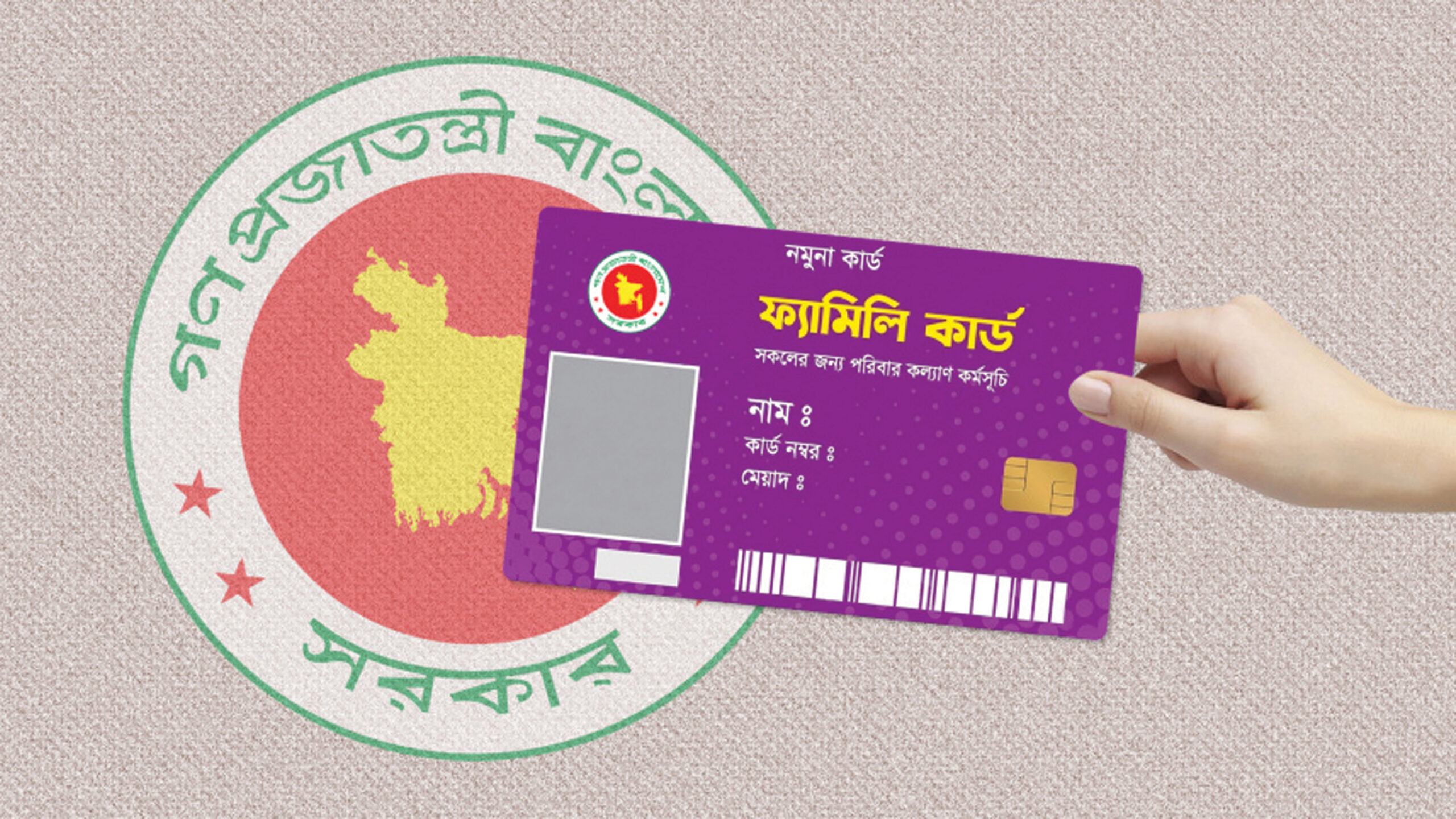
“Family is the core unit of development, not the individual.” On the basis of this core philosophy, Family Cards, as a groundbreaking step towards inclusive development, were the promise in the election manifesto of the Bangladesh Nationalist Party (BNP). Following the election, inaugurated on March 10, 2026 by Prime Minister, Tarique Rahman, has introduced the Family Card programme, which is projected to be a transformative social welfare programme. The idea of “family card” is mainly about financial support, food security, and women’s economic empowerment. Though this card is not a direct crimecontrol tool and it does not directly reduce specific crimes, but it will indirectly have a robust role to protect and to reduce violence against women, especially those linked to poverty and dependency. In Bangladesh, more than half of the population are women and they are regarded as the heart of national progress. Considering family cards facilities, it is significantly projected that protecting women and children from violence, especially violence against women and other gender related crimes through empowering them in decisionmaking, social recognition, and economic independence.
Understanding the Family Card
To begin with, we should be aware of what a family card is and what will be provided to women. The family card is a database-driven digital identification and social protection instrument designed to deliver regular financial assistance directly to vulnerable households. Family card gives monthly cash aid of Tk 2,500 (or other necessary commodities) to the adult woman as the head of the household. The Family Card will come with the latest technology, including contactless chips, QR codes, and Near Field Communication (NFC), which will unite all government assistance in one safe tool. What started as a pilot project to support 40,000 women-headed families is readily expanding and is projected to reach millions of families in a few years. Hence, an equitable, fair, and welleducated conscious society will be ensured through the just women’s empowerment, while extirpating all forms of violence,and gender crimes against women and girls.
Breaking the Cycle of Dependency and Violence
The most recent statistics from BRAC show a 41% rise in violence against women and children in Bangladesh. Additionally, 77% of violence against women is perpetrated by family members – husbands, fathers, fathers-in-law, brothers, uncles. In this context, family card will work as a new tool to protect some form of violence, including domestic violence, child marriage, close partner violence, torture, and educational barriers and safeguarding many others gender related crime not by directly influencing crime control strategies but by reducing dependencies. In Bangladesh and in the other parts of the developing world, one of the most powerful predictive factors of domestic violence is economic dependence. When women are not in control of their own resources, they are frequently abused, tortured, or forced to control just to guarantee their survival and that of their children. Let’s take a look at the following table to get a better Understanding, The idea and implementation of the Family Card programme may bring a positive change in this oppression and violence statistics. Putting money directly into the hands of women, be it in the form of bank accounts or mobile wallets, enables them to have financial independence and make decisions in the household. Economic stability decreases family stress-a key precipitant to intimate partner violence and domestic abuse. Self-reliant women are also in a better position to seek assistance, exit abusive relationships, or make better deals at home. By doing so, the Family Card will serve as a silent yet powerful barrier against torture and violence that are much too frequent to be kept under lock and key. Preventing Child Marriage and Boosting Girls’ Education The Family Card is a direct response to this, enabling mothers to invest in the future of their daughters. According to UNICEF, child marriage deprives girls of their childhood and their potential for the future. Child marriage can be stopped by means of education, which gives girls more choices to make and breaks the poverty cycle. When families receive consistent monthly assistance, they may feel less pressure to marry off their daughters as a way to reduce financial strain. Rather, mothers will be able to pay school fees, books, uniforms, and safe transportation, keeping girls in schools more. A UNFPA report of 2024 claims that the situation in Bangladesh is very grim, the country has the highest rate of child marriage in South Asia, with 47 percent of girls aged 18 to 24 years marrying before their 18th Birthday. The Family Card is stealthily creating a generation of empowered young women who will be respectful, careerdriven, and abusive-norm rejecters through the reduction in child marriage and early school dropouts.
Less Divorce, Family Fallout, and Greater Crimes
With women possessing their own resources, families become resilient to economic shocks. This buffer fund will help avoid situations where people are desperate and want to fight each other to the point of violence or divorce. Although the programme is not encouraging women to quit truly destructive marriages, it lessens the economic domination that holds many in unhealthy relationships. As a result, fairer families and a tangible reduction in GBVbased cases in the family courts will be guaranteed. The Family Card helps to make communities safer by lifting vulnerable families out of hardship. Women who are active economically are also more involved in local economies, micro-enterprises, and leadership in communities, which will also discourage crime and encourage social harmony. New tool, New voice: A Stronger, Safer Nation Vision The Family Card is not a mere welfare card, it is an affirmation of faith in Bangladesh women. Silently and pragmatically, it aims to address the structural foundations of gender-based violence and to facilitate learning, stability, and inclusion in the economy. It is emancipation, honor, and a better future. The preventive power of the family card will increasingly be experienced as the programme is no longer restricted to a pilot level but is extended to the whole country, a decrease in instances of domestic abuse, a decrease in the number of child marriages, an improvement in female literacy, a stronger family, and a more vibrant national economy.
Author
Superintendent of Police Dhaka District
Regional Coordinator Region-22
International Association of
Women Police (IAWP)