
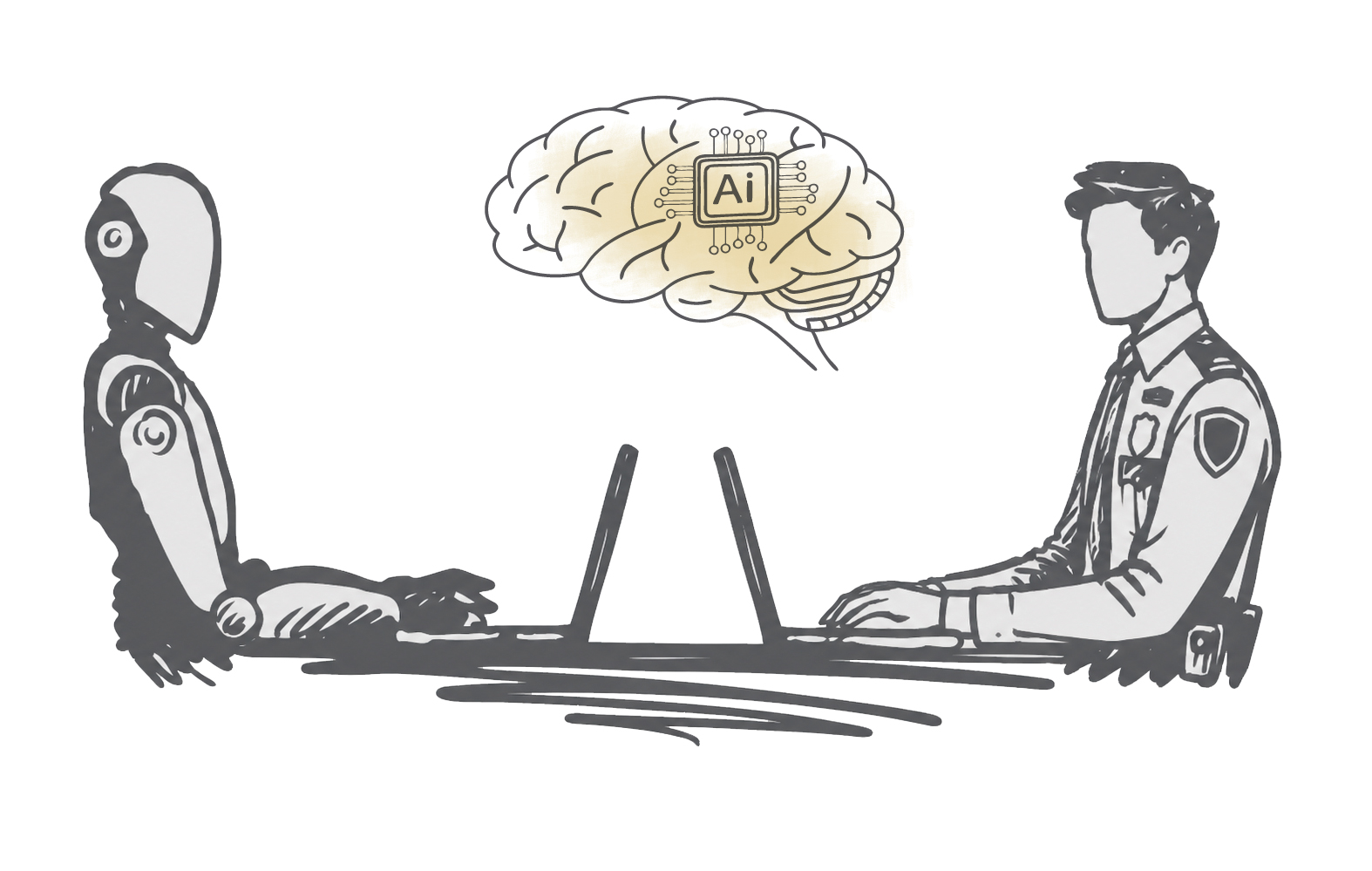
While policing has always been a challenging profession, the 21st century has introduced a host of new complexities.The rise of the internet and digital technologies has led to new forms of crime, such as hacking, identity theft, online fraud, and cyberterrorism.Policing these crimes requires specialized skills and resources. Criminals use encrypted communication tools and the dark web to operate anonymously, making it harder for law enforcement to track them.The spread of fake news and manipulated content online can incite violence or destabilize communities, creating new challenges for maintaining public order.Criminal networks operating across borders have become engaged in activities
like human trafficking, drug smuggling, and terrorism. Artificial Intelligence (AI) has the potential to significantly address many of the challenges faced by modern policing. By leveraging AI, law enforcement agencies can enhance efficiency, improve decision-making, and build stronger relationships with communities.
What is AI?
AI is a branch of computer science focused on creating systems and machines capable of performing tasks that typically require human intelligence. These tasks include learning, reasoning, problem-solving, understanding natural language, recognizing patterns, and making decisions. AI aims to mimic or replicate human cognitive functions, enabling machines to operate autonomously or assist humans in complex tasks. Key concepts in AI are Machine Learning (ML), Deep Learning, Natural Language Processing (NLP), Computer Vision, and Robotics. ML is a subset of AI that involves training algorithms to learn from data and improve over time without being explicitly programmed. It has found its wide use in the fields of predicting customer behavior, detecting spam emails, or recommending products. Deep Learning is a specialized form of machine learning that uses neural networks with multiple layers to analyze complex data and is found to be useful in imagerecognition, speech recognition, and NLP. NLP enables machines to understand, interpret, and generate human language by applying to chatbots, language translation, and sentiment analysis. Computer Vision allows machines to interpret and analyze visual information from the world, such as images and videos and have been dominating for facial recognition, medical image
analysis, and autonomous vehicles. Robotics combines AI with mechanical engineering to create robots that can perform physical tasks. Industrial robots, drones, and robotic assistants are widespread now-a-days in different industries.
How do police organizations use AI for enforcement purposes?
By leveraging AI, law enforcement agencies can enhance efficiency, improve decision-making, and build stronger relationships with communities. AI has successfully been used by many police organizations for combating cybercrime. It can analyze vast amounts of data to identify patterns indicative of cyberattacks, phishing attempts, or malware. AI algorithms can predict potential cybercrime hotspots or targets, allowing police to take preventive measures. It can assist in analyzing digital evidence, such as recovering deleted files or tracing online activities of suspects. Historical crime data can be analyzed
by AI to predict where and when crimes are likely to occur, enabling proactive deployment of resources and the technique has got the popular name as predictivepolicing. For improved crime prevention and Investigation, AI-powered facial recognition can help identify suspects or missing persons in real-time and by using the algorithms for pattern recognition, AI can detect patterns in criminal behavior, linking seemingly unrelated incidents to uncover organized crime networks. For the purpose of Real- Time Monitoring, AI can analyze live video feeds from surveillance cameras to detect suspicious activities, such as unattended bags or unusual crowd behavior. It can identify gunshots and alert police instantly, reducing response times. In traffic management AI can optimize traffic flow and detect violations, improving road safety and reducing accidents. By analyzing data on stops, arrests, and use of force, AI can help identify and mitigate biases in policing. Thus, by ensuring fairer practices, AI can help police organizations to strengthen community relations. AI powered chatbots can handle non-emergency inquiries, freeing up officers to focus on critical tasks and improving community engagement. In addressing terrorism and organized crime, by network analysis, AI can map out connections between individuals and groups involved in terrorism or organized crime. It can analyze global data to identify emerging threats and trends,aiding in counter-terrorism efforts. By using behavioral analysis algorithms, AI can
detect anomalies in behavior or communication that may indicate planning of criminal activities. In workforce management, AI can predict staffing needs based on crime trends, events, and other factors, ensuring optimal deployment of officers. By analyzing spending patterns, AI can recommend cost-effective strategies for resource allocation.Police organizations around the world have been using AI to enhance their operations.As an initiative of predictive policing, Los Angeles Police efforts. By using behavioral analysis algorithms, AI can detect anomalies in behavior or communication that may indicate planning of criminal activities. In workforce management, AI can predict staffing needs based on crime trends, events, and other factors, ensuring optimal deployment of officers. By analyzing spending patterns, AI can recommend cost-effective strategies for resource
Allocation. Police organizations around the world have been using AI to enhance their operations. As an initiative of predictive policing, Los Angeles Police Department (LAPD), USA uses PredPol to analyse historical crime data and predict where crimes are likely to occur. Kent Police, UK Implemented a predictive policing system called Qlik to identify crime hotspots and optimize patrol routes. New York Police Department (NYPD), USA uses facial
recognition technology to identify suspects by comparing images from surveillance footage with criminal databases. This has helped solve cases ranging from petty crimes to homicides. South Wales Police, UK have tested facial recognition technology at large public events, such as football matches and concerts, to identify individuals on watchlists. Chicago Police Department, USA uses ShotSpotter, an AI-powered acoustic sensor system, to detect and locate gunshots in real-time. This has significantly reduced response times to shooting incidents. In South Africa, Cape Town Police has also implemented ShotSpotter to combat high rates of gun violence in certain neighborhoods. London Metropolitan Police, UK use
AI-powered video analytics to monitor live CCTV feeds and detect suspicious activities, such as unattended bags or unusual crowd behavior. Chinese police use AI-driven surveillance systems to monitor public spaces, identify suspects, and track individuals in real-time. Europol uses AI tools to analyze large volumes of digital evidence, such as encrypted communications and social media data, to combat organized crime and terrorism. The FBI employs AI to recover deleted data from devices and analyze digital evidence in cybercrime investigations. Dubai Police use AI-powered systems to detect traffic violations, such as speeding and illegal parking, using cameras and sensors. They also use AI for accident analysis and prevention. In New Delhi, AI-based systems are used to monitor traffic
flow, detect violations, and mitigate congestion in realtime. Singapore Police use AI-powered chatbots to handle non-emergency inquiries and provide information to the public, improving accessibility and efficiency. Toronto Police have experimented with AI-driven platforms to analyze community feedback and improve public engagement. Israeli police use AI to analyze social media and communication patterns to identify potential threats and prevent terrorist attacks. The NYPD uses AI to monitor social media for threats and criminal activity, helping to prevent incidents before they occur. The Dutch National Police use AI-driven virtual reality (VR) simulations to train officers in de-escalation tactics and highstress
scenarios. Australian Federal Police use AI-powered training platforms to simulate real-world scenarios and improve decision-making skills. South Korean police use AI to analyze crime scene photos and videos, helping investigators identify evidence and reconstruct events. The FBI uses AI tools to enhance the analysis of forensic evidence, such as fingerprints and DNA samples.
Bangladesh Police could significantly benefit from adopting AI technologies, provided it is done thoughtfully and with proper safeguards. Bangladesh faces unique challenges in law enforcement, such as high population density, limited resources, and evolving crime patterns. AI can help address these challenges while improving efficiency, transparency, and public safety. However, its implementation must be carefully planned to avoid ethical, legal, and social pitfalls. Bangladesh Police often face resource constraints. AI can help optimize resource allocation by predicting crime hotspots, optimizing patrol routes, and automating routine tasks. Cybercrime is on the rise in Bangladesh, including online fraud, hacking, and digital harassment. AI can enhance digital forensics, detect cyber threats, and track cybercriminals. Dhaka and other major cities suffer from severe traffic congestion and accidents. AI-powered traffic management systems can monitor traffic flow,
detect violations, and reduce accidents. In tackling organized crime and terrorism, AI can analyze communication patterns, financial transactions, and social media to identify and prevent organized crime and terrorist activities. In improving public safety, AI can enhance surveillance systems to detect suspicious activities, monitor crowded areas, and respond to emergencies faster.
How can Bangladesh Police serve better using AI?
Bangladesh Police has already started using AI driven Body Worn Cameras and CCTV traffic monitoring systems. This initiative can be expanded by introducing AI powered facial recognition in high-security areas, such as airports, border checkpoints, and major public events, to identify suspects or missing persons. Expanding AIpowered cameras and sensors to monitor traffic violations, optimize signal timings, and reduce congestion; equipping cybercrime units with AI tools to analyze digital evidence, track online criminals, and recover
deleted data; deploying AIpowered chatbots to handle non-emergency inquiries in National Emergency Service-999, Bangladesh Police can step forward toward a modern policing system and, thus, can earn people’s trust and respect. Specialized organs like Anti Terrorism Unit (ATU), Rapid Action Battalions (RAB), Counter Terrorism and Transnational Crime (CTTC) Unit of DMP are tasked with combating terrorism, organized crime, and other high-priority security challenges, and can significantly benefit from the integration of AI technologies in their operations. AI-Powered Surveillance can be deployed to analyze real-time video feeds from CCTV cameras and drones to detect suspicious activities, such as unattended bags or unusual crowd behavior. AI can monitor social media platforms for threats, extremist content, or plans for criminal activities, helping RAB preemptively address
potential threats. Officers can be trained in AI technologies and data analysis to ensure they can effectively use these tools. They must collaborate with tech companies, academic institutions, and international organizations to access expertise and funding. However, there must be clear guidelines and regulations to ensure Al is used ethically, with respect for privacy and human rights. By integrating AI technologies, RAB can enhance its capabilities in countering terrorism, crime prevention, cybercrime investigation, and public safety. With the right approach, AI can be a powerful tool for RAB to meet the complex security challenges of the 21st century. The adoption of AI technologies by the Bangladesh Police has the potential to revolutionize law enforcement, making it more efficient, proactive, and
transparent. However, this must be done with careful planning, ethical considerations, and public engagement. By starting with pilot projects, building capacity, and addressing challenges, Bangladesh can harness the power of AI to create safer communities and
improve policing outcomes. However, addressing these ethical considerations is essential to ensuring that AI technologies are developed and deployed in a way that benefits society as a whole. This requires collaboration among technologists, policymakers, ethicists, and the public to create frameworks and guidelines that promote responsible AI innovation. By prioritizing ethics in AI, we can harness its potential while minimizing risks and ensuring that it serves the greater good.
Author
DIG (Retd.)
Bangladesh Police